The most successful managers aren’t those who set the highest goals – they’re the ones who excel at guiding their teams through the journey of achieving them.
How often have you got the question or better yet, how often have you asked the question “where do you see yourself in five years”. When you ask a prospective employee that… what do you expect to hear? Are you disappointed if they don’t know? What about yourself, have you really given it some thought? Personally… I don’t want to put myself in the confines of a five year plan! If I’ve learned anything in my career, is that things change, opportunities arise, and things come up that are unexpected.
But let’s get down to some nitty gritty. We absolutely should be setting goals for ourselves and for our employees every year. Not only should we be setting goals to help meet company objectives, but also goals that promote professional growth, learning, and development. Here’s the thing though, setting goals can feel overwhelming! We often hear about those ambitious five-year plans and lofty long-term objectives. And when organizations set annual goals for the company to meet, its hard to understand how you can have a direct impact. But the real magic happens when we break these down into smaller, achievable milestones. Let’s explore how to set and manage short-term goals that drive real results.
Why Short-Term Goals Work Better
Long-term goals can feel abstract and distant. When an employee hears “increase customer satisfaction by 25% this year,” they might struggle to connect that to their daily work. Start first with talking to your employee about how they think they can help influence the improvement of customer satisfaction. This may take going down several layers to get to how they have impact! For example, if you’re an accountant that never deals with a customer, how do you help increase customer satisfaction? Well, maybe the accountant works with a sales director and that sales director has managers who work directly with clients. So what is a way that accountant could work better with the sales director? You get the idea??
So once you’d identified how they can have that impact, start breaking this down into monthly or quarterly targets makes the goal tangible and actionable. They’re not going to do this in one month! So while you may have an overarching annual goal to increase customer satisfaction by 25%, break that down in to a monthly or quarterly objective and set your incremental goals that will ultimately lead to that big one! You may have a 4, 5, or 6 cascading goals that in the end will aim to drive to that ultimate goal.
Setting Short-Term Goals
So now that you know what kind of goals you need to set, how do you go about managaging them? There are two types of goals I’ll talk about, SMART goals and NICE goals.
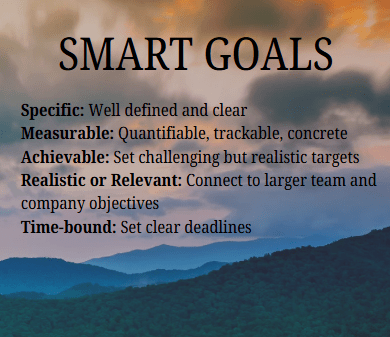
SMART goals is a term that was introduced in 1981 by a management consultant, George Doran. He established this system recognizing that businesses were too vague to be meaningful and to help managers set goals that were clear, acheivable, and measurable. Some of the objectives have been modified by others over the years, but you’ll get the idea…
There was another concept introduced by Ali Abdaal in his book Feel Good Productivity, called NICE goals. His intent with NICE goals was to simplify goal setting, make it easier especially maybe those new to it. I personally am a huge fan of this method because of the simplicity. Its not overly complicated.

The Check-in Framework
Regular check-ins are crucial for goal success. The last thing you want to do is give an employee their goal(s) and then just say ‘here you go, good luck’. So these check-ins are highly advisable! Depending on the goals you may want to check in more or less frequently, but you need to determine how you can best structure them based on how many employees you have, the structure of your business, and what kind of goals these are. If we use the example of improving customer satisfaction, you may have some metrics you can follow monthly! So why not check in monthly on action planning?
In those check-ins, review progress on current goals by analyzing metrics and results. Identify any obstacles and strategies if needed. Plan next steps between now and the next check in and provide immediate support or resources needed and of course, celebrate small wins!!
Guiding Without Micromanaging
Your role as a manager is to support, not control. Your job is to help facilitate them meeting their goal, but don’t try to micromanage the details.
Ask powerful questions:
“What resources would help you move faster?”
“Where do you feel stuck?”
“What have you tried so far?”
Provide tools and remove barriers. Share relevant training materials. Connect them with mentors if possible, even if yourself. Clear organizational roadblocks and if you can’t… reconsider that goal. Remember, whichever method you take, they need to be acheivable and controllable. If there is a roadblock in the way, then you cannot check those boxes.
Moving Forward
Remember, the key to successful goal-setting is balance. You want goals that stretch your employees while remaining achievable. Regular check-ins provide the support structure, while clear metrics show progress. By focusing on shorter-term objectives, you create an environment of continuous achievement and growth. Start implementing this approach today. Pick one important long-term objective and break it down into something like monthly goals. Schedule your first check-in and watch how this structured approach transforms your team’s performance!
 Elevated Consulting Partners
Leave a comment