Employee turnover is an issue that plagues every single business and company out there. According to the Bureau of Labor Statistics, turnover rates vary from 17% – 25% and in some cases even higher depending on the industry. Multiple studies have shown that the cost of turnover for entry level, hourly positions generally are around $1,500 per employee but can be tens of thousands of dollars. In most cases though, individual employee turnover cost could be up to 1.5-2.0 times their annual salary, with executive roles being even more. This ultimately impacts your bottom line, and if you have a higher turnover rate, this could have a very significant impact.
Because of this financial impact, you should understand what your turnover rate is, how you calculate your cost of turnover, and most importantly how to reduce your turnover.
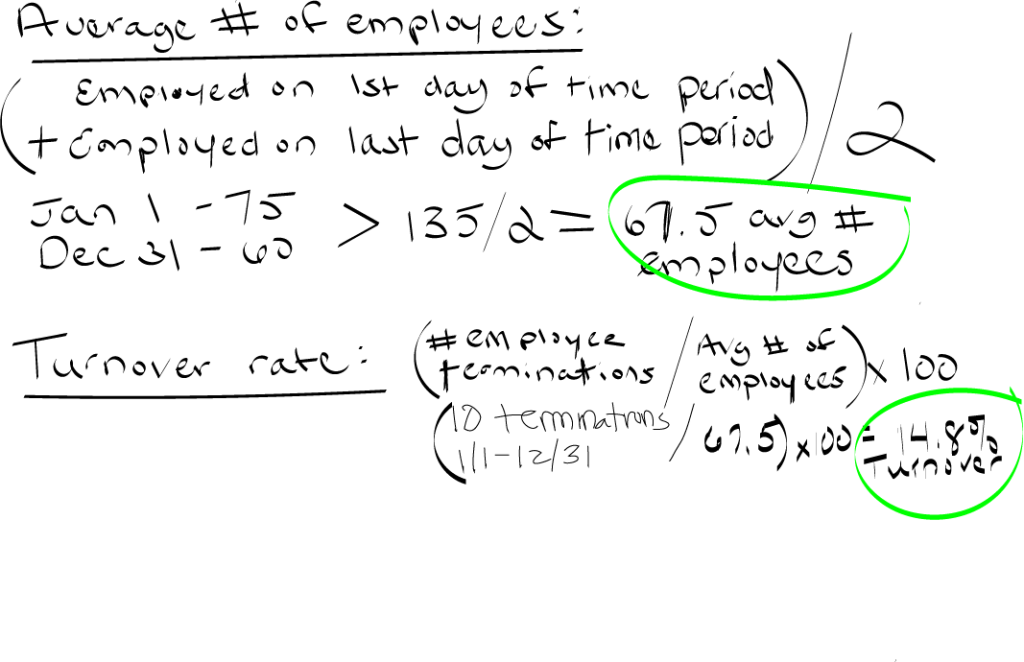
Let’s start with the first metric… turnover rate. When you determine what time period you want to measure (typically a calendar or fiscal year), first determine your average number of employees during that time. The easiest way to get that number would be to look at how many employees were active on day one of that time period, how many employees were active on the last day of that time period, divided by two.
(starting # of employees + ending # of employees ) / 2
Now to calculate your turnover rate, once you have your number of average employees, evaluate how many terminations you had in that time frame. Divide that by the number of employees, then multiple times 100.
(# of terminations/average # employees) x 100
In the example below, the turnover rate is 14.8%.
So, what’s next?? Now that you know what your turnover rate is, it would be helpful to understand two things.
1) What is your cost of turnover?
2) How are you going to remedy and improve your turnover rate?
Truthfully, it can be difficult to get to the actual number when it comes to cost of turnover. Why? Because so many of the costs are the ones that can’t be seen, they’re not really tangible… like instutional knowledge, loss of a subject matter expert, and productivity, to name a few. And something incredibly valuable to understand here is that there is a psychological impact to remaining employees when one leaves. Departure of a fellow employee can create distrust, lack of confidence in leadership, instability, or fear/discomfort.
Back to calculating that tangible expense though… To calculate, you would want to assess each expense related with the hiring, onboarding, and training of an employee. Evaluate the hours put in times an hourly rate of the recruiter and hiring manager. How much time do your HR associates spend with a new hire times their hourly rate? What about training from a fellow employee or yourself with getting someone up to speed? And if you are in an enviornment that produces “widgets”, what delay in revenue is there associated with their ability to be at 100%? All those expenses should be factored in to a cost of turnover analysis and in the example of a widget producing employee, ultimately should look something like this:
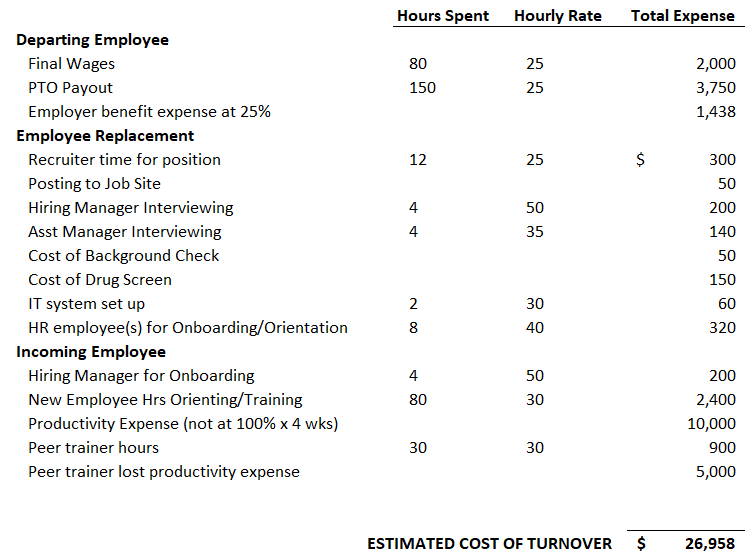
Something to consider on the above example is that we modeled this assuming this employee would be fully operational in 4 weeks, but the reality is that that job mastery often takes much, much longer than that. So while this may assume ramp up to self sufficiency, an employee 30 days in likely is not going to be as productive as someone with 2 years of experience.
Finally, how do you reduce your turnover? Let’s be clear, you will not completely eliminate employee turnover because there are things beyond your control that cause people to leave. However, understanding the “why” will help to ensure that you are doing everything within your power to ensure retention.
Exit Interviews: A proper exit interview can be a key tool to understanding the dynamics of departures. Employees who have left an organization will be far more forthcoming about their “why” when they aren’t fearful for the impacts to their job. In conducting exit interviews, companies should consider making this a mandatory part of the off boarding process for any employee. The questions should be performed by a person in Human Resources or by an experienced interviewer that really isn’t affiliated with their department. Consider ensuring that responses be confidential as to ensure they’ll be as forthcoming as possible. Finally, as part of the exit interview, ensure structured format and questions. Ask about job satisfaction, leadership, how they felt supported or unsupported in their career growth, and even if they would recommend the company to others. Keep in mind, exit interviews are a rear view look, so let’s dive in to way to proactively retain employees.
Surveys: One thing that happens time and again is employers conduct annual surveys to check the box of gleaning feedback from employees, but frequently, action simply is not taken or not articulated to employees on how their actioning. One of the best things you can do as either at an organizational or department level, take that feedback then work together with your leaders or teams to set goals on how to meet the demands of your employees. For example, if you have employees providing feedback that they have no growth pathway, meet with your teams and have an interactive discussion on how you can meet their goals. You may find that some want constructive or positive feedback, continuing education opportunities, or maybe even opportunity to sit in on meetings of interest to help them grow. But set those goals then make a plan on how you’ll help support this effort. Don’t leave it there though, check in periodically with your teams and make sure you’re keeping the intended trajectory.
One on Ones: In my personal experience, one on ones have been one of the most valuable tools to understanding my employees and ensuring their satisfaction in their job. But you should be all ears in these one on ones. Don’t be distracted by your phone, email, or other things. Give your employee your full undivided attention to help them feel valued and heard. Consider frequency. Depending on the size of your team and the work you do, you may want to meet with your employees weekly or monthly. In your one on ones, understand what they are working on, what barriers they are experiencing, how you can support them and if they have the tools they need to do their job. Active listening and action will help your employees feel more connected to you and the work they are doing.
Goal Setting: Outside of one on ones, do annual goal setting with your employees. These goals could be something to help them in their job and something to help them grow professionally. When setting goals, break them in to bite size, digestible goals. For example, if an employee wants to learn how to use pivot tables in Excel, you want to help create a timeline to success, milestones. So maybe the first milestone is signing up for and taking an education course (consider things like LinkedIn Learning or Coursera). Then, their next milestone is creating a pivot table and presenting it to you. Perhaps then their milestone is taking a specific project and having them work the data and present the pivot table to the team. This is a small example, but you get the idea. Creating milestones helps ensures that an employee is tracking to their goal, and then check in quarterly, make sure they’re hitting the milestones, and ask how you can support them hitting those milestones going forward.
Rewards and Recognition: Gestures of gratitude go very far with people. Both privately but also publicly. Consider a system where you can provide monetary recognition but also more frequent accolades too. Something as simple as little thank you cards or software recognition are helpful tools to achieve this. I had a team where we started off every team meeting with recognitions. Sometimes it was small, but this helped create an environment that recognized even the small efforts, and it was a great morale boost!
Training and Development: People generally want to grow, they want to learn, and advance. Now obviously, this is not every employee, but it is many. How do you provide that pathway. Does your company provide tuition reimbursement or a means for employees to attend conferences? Remember that if your employees have more skills relevant to their job, that has a tangible return on investment back to you. If you have a production line manager that attends a conference that helps them gain new insights and improve efficiency and increase outputs, that ultimately translates back to your company as decreased expense or increased revenue.
There are several other considerations you could assess for employee retention and job satisfaction, like culture, compensation, work life balance, etc, but these are some that every company should consider having in place.
At the end of the day, actively listen to the demands and desires of those helping to make your company successful, because you’re not doing this alone. Think objectively and consider every opinion. Some things may be achievable, some may not be. But if you want to decrease the overall expense of employee turnover, making your employees feel valued will help keep them around and will improve your bottom line and lead to greater success!
 Elevated Consulting Partners
Leave a comment